
A Wild, a Golden Symbol and a Scatter can appear in the same slot family while doing different jobs. One may help form a win, another may change after an event, and another may activate a feature. To read the rule correctly, separate the symbol’s role, the condition that changes it and the moment the result is evaluated.
This Jiliko guide follows the question already raised in our Super Ace game files: how do transformations and Scatter conditions differ? We checked three JILI product pages on 4 October 2026, then used invented examples to explain the gaps a short description cannot fill.
Three related titles, three different reading questions
| Exact title and source | What the page states | What to investigate in the rules |
|---|---|---|
| Super Ace · 49 | A Golden Joker appears after a Golden Card is eliminated. | The sequence of elimination, transformation and the next evaluation. |
| Super Ace Joker · 409 | Cleared Golden Symbols produce Wilds; Mystery Symbols and multipliers are described separately. | When a symbol changes, what it can replace and when any multiplier applies. |
| 3 Super Ace · 588 | Three Scatter types enhance Free Games; features can activate individually or together. | Required counts, type combinations and the enhancement attached to each condition. |
The last column is our reading framework, not a claim that the public page supplies those answers. The records identify events but do not establish all the version-specific substitution exclusions, trigger combinations or retrigger conditions.
Keep the full title with your notes. The Super Ace file, Super Ace Joker file and 3 Super Ace file are separate records. A familiar family name is not permission to copy a rule from one into another.
Separate what a symbol does from when it changes
Start with the role: does the symbol substitute in a paying combination, activate a feature, reveal another symbol or change a multiplier? Then find the condition: does the change follow a qualifying win, an elimination, a collection threshold or entry into another mode? Finally locate the evaluation step. A later transformation should not be counted backwards as if it had already existed at the previous step.
For an invented teaching example, imagine a rule that pays an existing combination, clears it, and only then changes a marked card into a Wild for the next evaluation. The newly created Wild belongs to that next evaluation. This illustrates why order matters; it does not specify the complete sequence of any game in the table.
Likewise, “Wild” alone does not settle which symbols it replaces, whether it expands or stays in place, or whether it substitutes for a feature trigger. Read each explicit inclusion and exclusion. If the help is silent, leave the detail unconfirmed instead of treating every special symbol as interchangeable.
Three symbols are not necessarily three types
A count answers “how many?” A type answers “which kind?” Three appearances of one kind and one appearance of each of three kinds both contain three symbols, but their composition differs. That distinction is useful when a product description names several Scatter types without reproducing its full activation table.
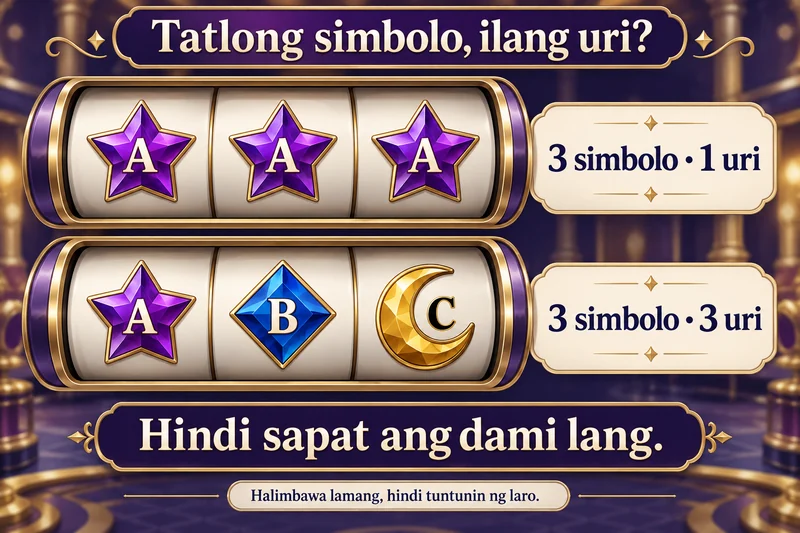
In the following invented example, A, B and C are teaching labels, not the actual Scatter names, colours or rules of 3 Super Ace. Compare two imaginary conditions: Rule 1 needs any three symbols from this set; Rule 2 needs at least one A, one B and one C.
| Symbols shown | Total / distinct types | Rule 1: any three | Rule 2: A, B and C |
|---|---|---|---|
| A · A · A | 3 / 1 | Met | Not met |
| A · A · B | 3 / 2 | Met | Not met |
| A · B · C | 3 / 3 | Met | Met |
The exercise does not choose which condition a real game uses. It shows the information missing when someone says only “get three Scatters.” The actual rules may count types differently or add positional conditions; that requires a source for the exact version.
Entry, enhancement and retrigger are separate questions
Draw three boxes in your notes: enter the feature, change the feature and extend the feature. Put a condition in a box only when the rules connect it to that action. A symbol that improves a mode already running need not be its original entry trigger. A condition for the first entry need not be the condition for awarding extra spins later.
For each box, record the symbol or type, required count, allowed positions, awarded effect and timing. “The page mentions three types; their full condition table is not inspected” is a useful incomplete record. It is clearer than assigning an invented number of free spins to every combination.
A multiplier needs a qualifying amount
Keep the older guide’s arithmetic, but keep its condition too: a 2× multiplier on a qualifying ₱50 win gives ₱100. It does not automatically multiply the whole balance, a separate Scatter award or the final feature total. Those are different amounts with different scopes.
If a fictional round contains a ₱50 eligible win and a separate ₱10 award, a rule applying 2× only to the first would give ₱100 + ₱10 = ₱110. A rule applying 2× to the combined ₱60 would give ₱120. Neither is a verified Super Ace payout rule. The ₱10 difference comes entirely from the stated scope, which is why the wording must come before the calculation.
Use the paylines and ways guide when the underlying win itself is unclear. A symbol count, a ways count and a multiplier are different quantities; none by itself reveals a feature’s probability.
What this update establishes
This update replaces broad catalogue word counts with three directly linked examples and a practical way to record role, count, type and timing. The A/B/C and peso tables are our hypothetical explanations, not observations from play. We did not audit all 100 titles again, inspect a logged-in game configuration or measure trigger rates.
Originally published 23 September 2026; updated 4 October 2026. Research, writing and Tagalog translation are AI-assisted, with no confirmed named human reviewer. The images are AI illustrations, not game screenshots. Read our editorial policy, use contact and corrections for a source change, or return to the Jiliko homepage for the wider collection. Reading a rule does not require a deposit or paid spin.