
Cascade win totals: do not add a running total to itself
If a cascade display shows running totals of 6, 14 and 17 units, the completed round total is 17 units—not 37. The earlier amounts are already included in the later amount. You must know whether each screen reports a new step award or the accumulated award for the round.
This guide in the Jiliko slot library turns that distinction into a small ledger. All screens, units and debits below are invented. They are not provider screenshots or a record of an actual account.
Give the round one identity
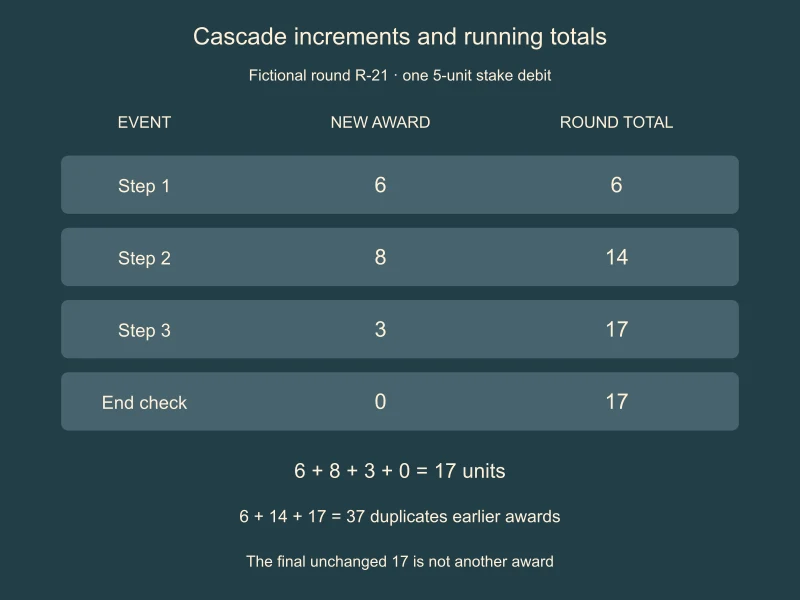
Assume fictional round R-21 has one initial 5-unit stake debit. Under the declared example rule, subsequent cascades belong to R-21 and require no separate stake debit. The visible award field is explicitly labelled “round win so far”, and it resets at the beginning of the next round.
Three successful steps occur. The first adds 6 units, the second adds 8, and the third adds 3. A final non-awarding check ends the sequence. Our model has no extra purchase, multiplier, jackpot, refund or other transaction. Those assumptions make the example complete without claiming that every real game uses the same arrangement.
| R-21 event | New step award | Round win so far | New stake debit |
|---|---|---|---|
| Initial commitment | 0 | 0 | 5 |
| Successful step 1 | 6 | 6 | 0 |
| Successful step 2 | 8 | 14 | 0 |
| Successful step 3 | 3 | 17 | 0 |
| End check, no new award | 0 | 17 | 0 |
Two routes to the same completed total
If the record supplies individual step awards, add them: 6 + 8 + 3 + 0 = 17. If it supplies accumulated values, use the final settled total of 17 or recover the increments from differences: 6 − 0 = 6, 14 − 6 = 8, 17 − 14 = 3, and 17 − 17 = 0.
Adding the first three accumulated values gives 6 + 14 + 17 = 37. The first six-unit award has then been counted three times and the second eight-unit award twice. The excess is 2 × 6 + 8 = 20, which explains the difference between 37 and 17.
The unchanged 17 on the end screen is another snapshot of the same total. It is not a second 17-unit award. Adding it to the mistaken 37 would make 54 and introduce another duplicate.
Do not confuse animation steps with paid rounds
Our ledger contains one paid round and three awarding steps, followed by an end check. The total stake debit is 5 units because the model explicitly records just one debit. Deducting 5 for every awarding screen would invent 10 units of additional spending.
The completed gross award is 17 units. Relative to the only recorded debit, the round's net change is 17 − 5 = 12 units. That describes this invented round only; it is not a payout forecast, account balance or proof of a withdrawal. A real history can include separately confirmed purchases and adjustments that need their own entries.
If you are reading a sequence-oriented game file such as the Super Ace profile, use its current game help to identify what its own counters display. The numbers in R-21 are not Super Ace values, and no live edition was played to create them.
Start a new comparison when the round changes
Suppose the next fictional round, R-22, ends with a 4-unit gross award. Its counter starts at zero. You cannot interpret the change from R-21's final 17 to R-22's final 4 as a negative 13-unit step within R-21; the identities differ.
The two completed gross awards are 17 + 4 = 21 units. If R-22 also has a separately recorded 5-unit debit, the two-round net is 21 − 10 = 11. Subtracting adjacent screenshots without their round IDs would lose that distinction.
The respin counter reset example makes a related point about remaining turns: a snapshot is not automatically an amount to add. Remaining turns, round win so far and wallet balance each describe different quantities.
Leave incomplete records incomplete
If only the screens labelled 6 and 14 survive, you know the accumulated award shown at the second observed point was 14. You do not know that it was the settled final total. If the label itself is missing, you cannot determine whether 6 and 14 were increments or running totals from their numerical size alone.
A practical note keeps the round ID, field label, currency or credit basis, sequence order and settlement status together. Preserve a missing step as missing rather than filling it with zero. An unchanged display proves only that the observed value did not change between those observations; it does not reconstruct an unobserved event.
The UK Gambling Commission's RTS 2 provides a Great Britain reference for understandable stakes and currency or credit conversions. It does not prescribe this fictional cascade counter or certify a Philippine operator. The ledger arithmetic is our own.
The R-21 calculation, the repeated end-screen case and the R-22 boundary were checked on 10 October 2026. This is an original reading exercise, with no real spin, purchase, wallet transaction or operator configuration tested.