
PAGCOR on AI and a changing rulebook: what was said in September 2026

Short answer — In two speeches three days apart, PAGCOR said its rules must change with the times. On 14 September 2026, Atty. Jessa Mariz Fernandez, Assistant Vice President of PAGCOR's Electronic Gaming Licensing Department, said artificial intelligence can help regulators "detect fraud" but can also make fraud "more sophisticated and harder to detect". On 17 September 2026, Chairman and CEO Alejandro Tengco said the framework "will continue to evolve" and named one concrete change: separating PAGCOR's regulatory and operating functions, a proposal now with the Governance Commission for GOCCs. No new rule was announced, and no AI-specific regulation has been published.
Speeches are easy to over-read. This article separates what PAGCOR actually announced from what it only signalled, lays out the steps the decoupling proposal still has to pass, and adds one set of hard numbers from PAGCOR's own files that shows how player-protection tools are being used right now.
What did PAGCOR say about AI on 14 September?
According to PAGCOR's own headline of 14 September 2026, Atty. Fernandez gave the keynote at the CiG iDEA Summit, held at the Hilton Manila ballroom at Newport World Resorts in Pasay City as part of the Inside Asian Gaming Expo week. Her main points, in her words:
- AI cuts both ways. "The same technology that can help us detect fraud, identify unusual activity, improve compliance, and make regulatory processes more efficient can also be used to make fraud more sophisticated and harder to detect."
- Adapt, do not resist. "The challenge, therefore, is not to resist technology. It is to ensure that our regulatory frameworks evolve alongside it."
- Old assumptions are not enough. "We cannot regulate tomorrow's technology using only yesterday's assumptions."
- The balance she described. Regulation "must be responsive without being reactionary", encourage innovation "without losing sight of responsibility", and protect consumers "without unnecessarily restricting legitimate enterprise".
The release says PAGCOR "continues to review its policies", engage with "legitimate industry stakeholders" and coordinate with other government agencies. It does not describe any specific AI tool PAGCOR uses or plans to use, any timetable, or any draft rule.
Why the speaker's department matters
Atty. Fernandez speaks for the part of PAGCOR that most online players deal with indirectly. PAGCOR's Electronic Gaming Licensing Department page says the department regulates local gaming operations other than land-based casinos, including electronic casino games ("eCasino"), electronic bingo, sports betting, specialty games, online poker and numeric games, together with "the online operation of their respective online gaming platforms". It accredits the service providers behind those platforms and approves or denies "all requests for approval of electronic gaming platforms or systems together with the games or contents to be deployed".
That is where AI tools would matter first in practice. A department that approves platforms and the games running on them is the one that would set any future expectations for automated fraud checks, unusual-activity monitoring or identity verification on licensed sites. Her speech did not announce such expectations. It does tell you which office to watch: a future circular from the licensing side, rather than a broad policy statement, is what would turn "frameworks must evolve" into something a platform, and therefore a player, has to follow.
The same page notes that a platform's online operation is an "adjunct service" to a licensed gaming venue's registered players. Any new technology rule would therefore reach players through the licensed operators and their accredited platforms, not through a separate set of rules written for individuals.
What did Chairman Tengco add on 17 September?
PAGCOR's headline of 17 September 2026 reports Tengco's keynote at The Regulators Forum, also at Newport World Resorts. He said the framework "will continue to evolve as conditions change" and that "what matters is that we remain open to corrections, that we are willing to learn, and that we are prepared to act when change is necessary."
His one concrete item was the planned decoupling of PAGCOR's regulatory and operating functions. PAGCOR currently both regulates the industry and runs its own casinos; Tengco said separating the two would "ensure that all legitimate operators compete on a level playing field". The release sets out the process, which we summarise as a timeline:
| Step | Who | Status on 17 Sep 2026 (per PAGCOR) |
|---|---|---|
| 1. Review the decoupling proposal | Governance Commission for GOCCs (GCG) | Under review, "decision expected soon" |
| 2. Endorse to the President | GCG to the Office of the President | After the review is completed |
| 3. Decide | President Ferdinand Marcos Jr. | "If [he] finds merit" |
| 4. Implement | Executive order | Would be issued only after step 3 |
That is four steps, of which none was complete when Tengco spoke. Until an executive order is issued, the change is a proposal, and its details, including which body would end up licensing online platforms, are not public.
Why would separating the two roles matter?
PAGCOR's industry data shows how large its own operating arm is. In the second quarter of 2026, PAGCOR-operated casinos generated ₱2.91 billion of the industry's ₱88.14 billion gross gaming revenue, according to the 2Q 2026 industry data file. That is 3.3% of the total, by our calculation. The share is small, but it means the regulator also competes in the market it regulates, which is the conflict Tengco's "level playing field" remark points to.
Is any of this a new rule for players?
No. Comparing the two releases line by line, here is what was and was not announced.
| Topic | Announced? | What the releases actually say |
|---|---|---|
| AI-specific regulation | No | Frameworks must "evolve alongside" technology |
| AI tools used by PAGCOR | No | AI "can help us detect fraud" (general statement) |
| Decoupling of regulator and operator | Proposal | Under GCG review; needs presidential approval and an executive order |
| Changes to player rules (age, exclusion, limits) | No | Not mentioned |
| Timetable | No | GCG decision "expected soon"; no date |
For a player, the existing rules still apply in full. PAGCOR's responsible gaming page lists persons under 21, government officials and employees, and people in the National Database of Restricted Persons (NDRP) among those barred from all online gaming platforms.
What do PAGCOR's own numbers show about player protection?
Fraud detection is one side of the technology debate. The other is whether players are using the tools already available to protect themselves. PAGCOR publishes player-exclusion counts from the NDRP, and they have moved sharply.
| Period | Self-exclusions | Family exclusions | Licensee-initiated | Total |
|---|---|---|---|---|
| Full year 2025 | 2,430 | 222 | 37 | 2,689 |
| 1Q 2026 | 3,046 | 51 | 4 | 3,101 |
| 2Q 2026 | 3,528 | 61 | 1 | 3,590 |
| First half 2026 | 6,574 | 112 | 5 | 6,691 |
Figures are from PAGCOR's exclusion files as of 31 December 2025 and as of 30 June 2026. By our calculation, self-exclusions in the first half of 2026 were 2.7 times the whole of 2025, and the jump started in the fourth quarter of 2025, when 1,602 were recorded against 351 in the quarter before. The June 2026 file shows 9,430 existing exclusions in the database after 3,456 had expired.
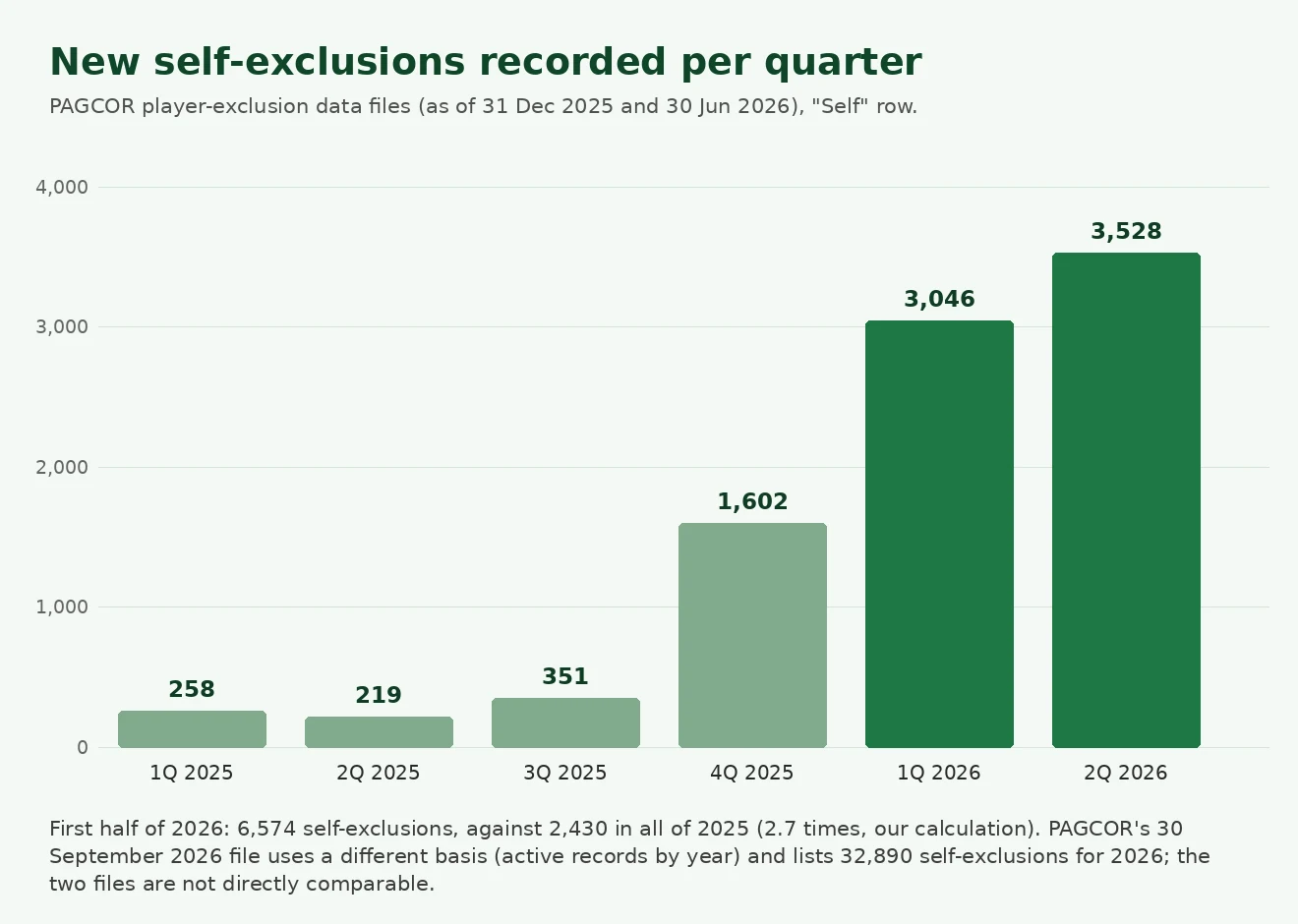
A third file, dated 30 September 2026, counts "active NDRP records" by year and lists 33,800 for 2026, of which 32,890 are self-exclusions. It uses a different basis from the quarterly files, and PAGCOR does not explain the difference, so we do not subtract one from the other to estimate a third-quarter figure. What all three files agree on is direction: far more people are excluding themselves than a year earlier. The files do not say why. The rise coincides with a period of tighter payment rules and an online self-exclusion portal, but the data cannot show cause.
What should players take from September's speeches?
- Nothing changes today. Both speeches describe direction, not rules. Watch for an executive order on decoupling and any PAGCOR circular that actually names AI or new monitoring duties.
- Expect more monitoring, not less. When a regulator says AI can "identify unusual activity", the practical result for players is usually more account checks by licensed platforms, not fewer.
- Use the tools that already exist. PAGCOR's responsible gaming page links its online self-exclusion portal, a family exclusion form and the National Problem Gambling Helpline, and advises checking a site at pagcorguarantee.ph before you play or pay.
Sources (checked 22 October 2026): PAGCOR, 14 September 2026; PAGCOR, 17 September 2026; PAGCOR 2Q 2026 industry data and player-exclusion files linked above; PAGCOR responsible gaming. The process timeline, shares and ratios are our summary and calculation.