
JILI official max-win caps across 111 slot pages: what the numbers mean
Published — UTC
JILI's official game pages publish a MAX WIN multiple for each title. On the 111 slot pages we could read on 15 October 2026, the caps run from 100x to 25,000x, the median is 3,000x, and 40 titles (36%) list 10,000x or more. Those pages do not publish RTP or hit frequency. This article therefore compares the caps and what they mean in pesos. It does not rank games by return and does not say which title is more likely to pay.
What the official pages publish
Each JILI game information page lists a game type, a MAX WIN figure, a volatility label (LOW-MED, MED, HIGH-MED or HIGH), special features, paylines or ways, and a publish date. For example, the Fortune Gems 500 page shows MAX WIN 12,500x, volatility LOW-MED, 5 lines and publish time 2026.7. The company's game listing links to these pages.
The pages do not give an RTP, a hit frequency or a bet range. On the 111 slot pages we parsed, none contained an RTP figure. They also do not say which stake the MAX WIN multiple is applied to. Any peso figure built on a cap is therefore a conversion we chose, not an official number.
How we counted
We collected 277 page IDs from the public game listing and homepage, then requested each page with showGame=false on 15 October 2026. 111 pages returned a slot layout with both a MAX WIN value and a volatility label. The other 166 responses did not contain both fields in that layout; 23 of them are fish or arcade titles. We excluded them. The figures describe that snapshot. Official pages can change, so check the live page before you quote a number.
Caps by volatility label
The table groups the 111 slot pages by the volatility label printed on each page. The median is the middle value of each group.
| Label | Pages | Median cap | Lowest | Highest |
|---|---|---|---|---|
| LOW-MED | 58 | 2,000x | 100x | 25,000x |
| MED | 37 | 5,000x | 1,000x | 25,000x |
| HIGH-MED | 15 | 10,000x | 2,000x | 25,000x |
| HIGH | 1 | 2,000x | 2,000x | 2,000x |
| All slot pages | 111 | 3,000x | 100x | 25,000x |
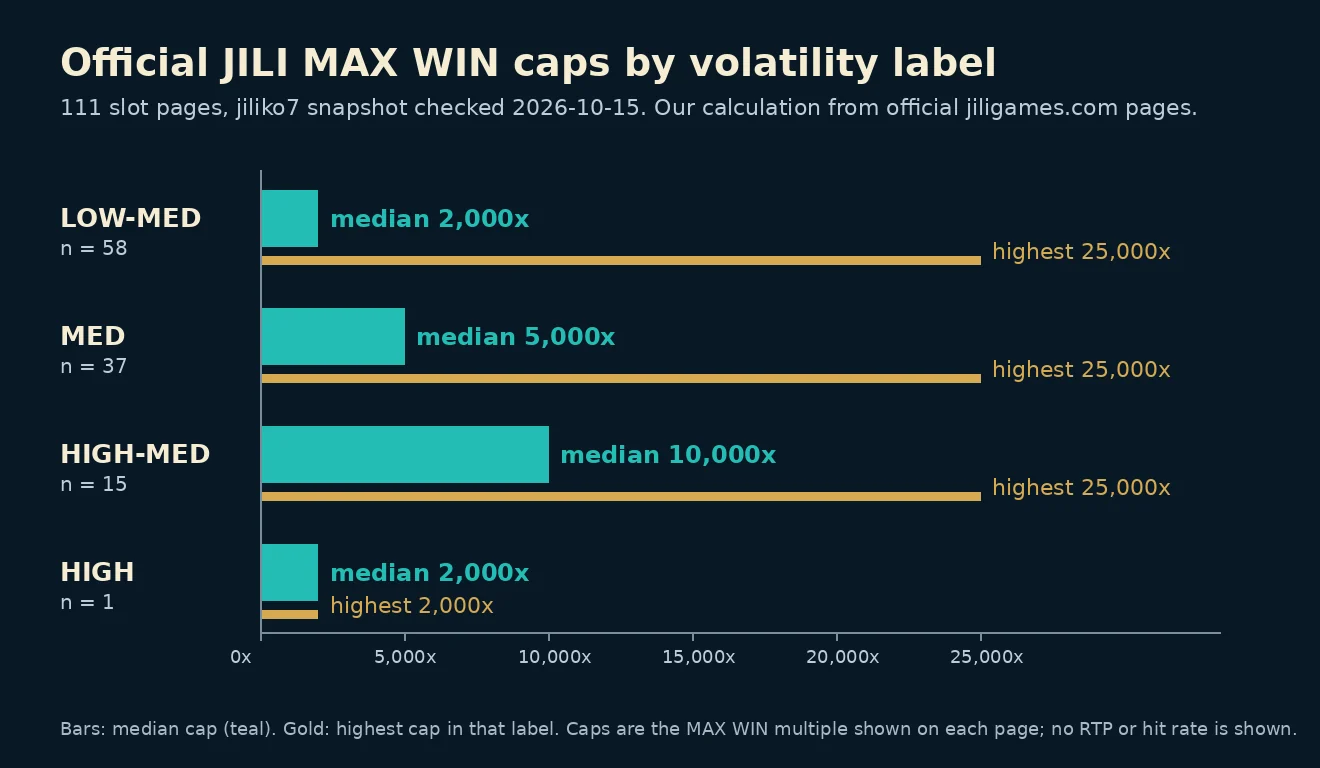
The label tracks the cap only loosely. HIGH-MED titles have the highest median, yet the same 25,000x ceiling appears under LOW-MED (Fortune Garuda 500) and MED (Golden Empire 2). A reader who uses the volatility label as a stand-in for the top prize will sometimes be wrong. The official pages give the label but do not define it numerically.
Caps as peso ceilings
A cap is a multiple. The peso ceiling is the cap multiplied by the stake. The pages do not state the stake base, so the table below is a hypothetical conversion at two stakes we chose for illustration: ₱20 and ₱100. Check the stake options in each game before using these figures. For example, 25,000 × ₱20 = ₱500,000.
| Title (official page) | Label | Cap | At ₱20 | At ₱100 |
|---|---|---|---|---|
| Golden Empire 2 | MED | 25,000x | ₱500,000 | ₱2,500,000 |
| Party Ape | HIGH-MED | 25,000x | ₱500,000 | ₱2,500,000 |
| Fortune Garuda 500 | LOW-MED | 25,000x | ₱500,000 | ₱2,500,000 |
| Fortune Gems 500 | LOW-MED | 12,500x | ₱250,000 | ₱1,250,000 |
| Super Ace | LOW-MED | 10,000x | ₱200,000 | ₱1,000,000 |
| Thor Dice | LOW-MED | 100x | ₱2,000 | ₱10,000 |
The spread is wide. The highest cap in the set is 250 times the lowest (25,000x against 100x), so the same stake can produce very different ceilings. That is arithmetic on the listed caps, not a forecast of what a player will win.
How the caps cluster
The 111 pages list 25 distinct caps. Round values dominate: 10,000x appears on 30 pages (27%), 2,000x on 17 and 1,000x on 15. The table shows the common caps and the rare top values.
| Cap as listed | Pages | Share of 111 |
|---|---|---|
| 10,000x | 30 | 27% |
| 2,000x | 17 | 15% |
| 1,000x | 15 | 14% |
| 5,000x | 10 | 9% |
| 3,000x | 7 | 6% |
| 12,500x, 15,000x, 20,000x | 2 each | 2% each |
| 25,000x | 3 | 3% |
The 40 pages at 10,000x or above are a large share of the catalogue, not a rare outlier group. The very top of the range is thin: only three pages list 25,000x. A reader who sees the highest value in a catalogue summary should expect it to belong to very few titles.
Does the layout change the cap?
The pages describe the paytable in three ways: fixed lines (or a bare line count), ways or Megaways, and cluster or cascade mechanics. We grouped the pages by the wording printed in the payline field. Three pages print no count (Golden Temple, Aztec Priestess and Thor Dice), so they fall into a fourth group that we do not analyse further.
| Printed layout | Pages | Median cap | Caps at 10,000x or more |
|---|---|---|---|
| Fixed lines or bare count | 77 | 3,000x | 27 |
| Ways or Megaways | 24 | 5,000x | 10 |
| Cluster or cascade | 7 | 5,000x | 3 |
| Not stated | 3 | 3,000x | 0 |
Ways and cluster titles have higher medians here, but the groups are small and the field is free text, so this is a description of the snapshot, not a rule. Read the layout on each game page before comparing caps across mechanics.
What a cap cannot tell you
- Frequency. A cap is the largest award the page lists. It does not say how often a spin reaches it. Without an official hit frequency or RTP, the chance of reaching 25,000x cannot be calculated from these pages.
- Typical outcomes. A median of 3,000x across the catalogue describes the listed ceilings, not the results of play. The official pages do not say how often any result approaches its cap.
- Label versus cap. A HIGH-MED label does not guarantee a higher cap than a LOW-MED label, as the overlap in the table shows.
Checklist before comparing two JILI titles
- Read the MAX WIN, volatility label and publish date on the official page the same day you use them.
- Find the stake and bet options in the game's own information screen before converting a cap to pesos.
- Keep the cap separate from return. A cap does not reveal RTP, and an RTP does not reveal the cap.
- If you need a frequency or return figure, look for a source that publishes it. The JILI pages checked here do not.
The useful comparison is the spread of caps across the catalogue, not one top number. The official pages give one fact per title, and this snapshot shows how those facts cluster. Frequency and return questions need a different source.