
DOJ says POGO-linked scam hubs persist in smaller operations: what was said, and what the ban covers

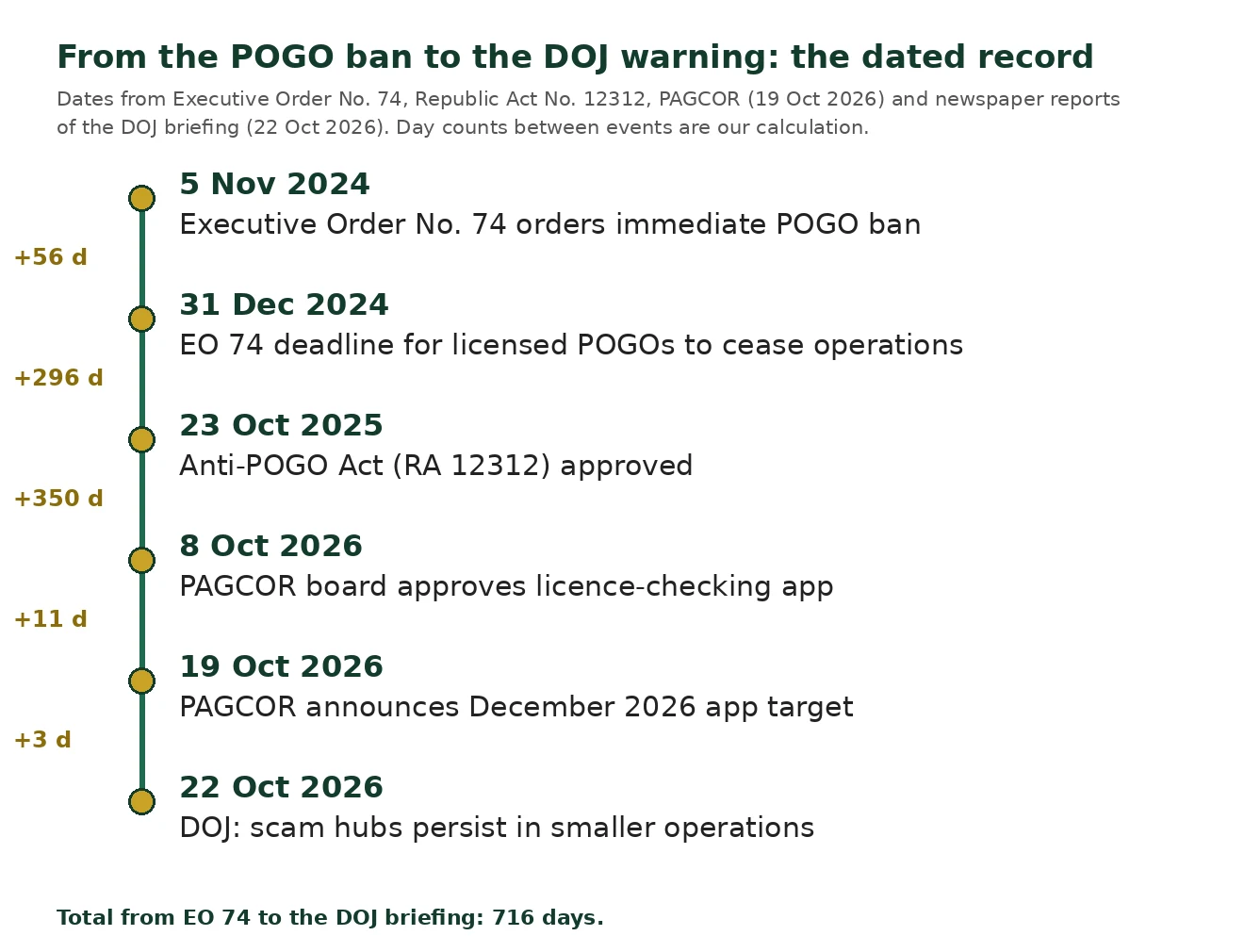
Short answer — At a media briefing on Thursday, 22 October 2026, Justice Undersecretary Nicholas Felix Ty said scam hubs and human trafficking linked to POGOs are still being found in the Philippines, but that recent raids have generally uncovered smaller operations, some in a single room, rather than the multi-building compounds of earlier years, as reported by The Manila Times and Daily Tribune. The DOJ is also examining whether foreigners found in these hubs entered visa-free or overstayed, and is still compiling figures. The briefing came 364 days after Republic Act No. 12312, the Anti-POGO Act of 2025, was approved on 23 October 2025, and 716 days after Executive Order No. 74 ordered the ban on 5 November 2024, by our calculation.
For Filipino readers, the practical point is that a smaller operation is harder to see. The same networks that ran large hubs can reach people through fake job offers and unlicensed gaming sites. Below we set out what the DOJ was reported to have said, what the law actually prohibits, and the checks that PAGCOR itself recommends. Everything about the briefing is attributed to the newspapers that covered it; we did not attend it, and we have not seen a DOJ transcript.
What did the DOJ say on 22 October?
Two Manila newspapers published accounts on the same day. Their reports agree on the main points:
- Smaller scale. The Manila Times reported that Ty acknowledged scam operations remained a concern, while recent raids "have generally involved smaller operations than the sprawling, multi-building compounds previously uncovered", with some cases involving "small-scale or even single-room operations".
- Not eliminated. Daily Tribune reported that the official "stressed that the reduced scale of the operations did not mean the problem had been eliminated", and that he described some recent targets as "mom-and-pop operations". The Manila Times reported that he cautioned a resurgence "remains possible".
- Entry routes under review. Both papers reported that the DOJ is looking at how foreign nationals found in scam hubs entered the country, including visa-free entry and overstaying, and that the department is still consolidating the numbers.
- Nationalities. The Manila Times reported Ty as noting that recent cases "reportedly involved mostly Chinese nationals", compared with a wider mix in earlier raids. Daily Tribune reported that he cautioned against attributing this to a single cause while information is still being gathered.
- Cross-border. Both reports cite Filipinos rescued from scam operations in Myanmar, Laos and Cambodia as evidence that trafficking networks recruit in one country and exploit in another.
Neither report gives a count of raids, victims or arrests for 2026, and the DOJ had not published its visa-free or overstay figures at the time of the briefing. We therefore make no claim about whether scam activity is rising or falling in number; the reported change is in the size of individual operations. One detail differs between the reports: Daily Tribune names the official as "Nicholas Ty" of the DOJ's Human Security and Peace Cluster, and at one point attributes a Filipino-language quote to a "Feliciano". Because that attribution is unclear, we do not repeat the quote.
What does the POGO ban legally cover?
Two official instruments matter, and they work differently. Their full texts are published by the Lawphil Project (Executive Order No. 74) and the Lawphil Project (Republic Act No. 12312).
| Instrument | Date | What it does, as written |
|---|---|---|
| Executive Order No. 74 | 5 November 2024 | Orders the "immediate ban" of POGO, internet gaming and other offshore gaming; stops new licences and renewals; requires licensed operators to cease operations "on 31 December 2024 or earlier". |
| Republic Act No. 12312, Anti-POGO Act of 2025 | Approved 23 October 2025 | Declares offshore gaming unlawful; permanently revokes POGO licences, related work permits and visas; sets prison terms and fines; makes violations a money-laundering predicate offence; repeals RA 11590, the law taxing POGO operations. |
| PAGCOR licence-checking app | Board approval 8 October 2026; launch targeted for December 2026 | A mobile app to help players identify PAGCOR-licensed online gaming platforms, according to PAGCOR's 19 October 2026 announcement. |
The executive order was a presidential directive; the Republic Act turned the ban into statute. Section 4 of RA 12312 lists the prohibited acts, including operating offshore gaming, accepting bets for it, creating a "POGO hub or POGO site", and aiding it by "leasing, subleasing, using, or allowing the use of any house, building" for prohibited activities. The law takes effect fifteen days after publication; we did not verify the publication date, so we do not state an exact effectivity date.
Penalties written into RA 12312
Section 13 sets three tiers. The figures below are copied from the law; the comparison column is our calculation.
| Offence | Imprisonment | Fine | Note (our calculation) |
|---|---|---|---|
| First | 6 to 8 years | Not less than ₱15 million | Floor of the scale |
| Second | 8 years 1 day to 10 years | ₱15 million to ₱30 million | Fine ceiling is 2× the first-offence floor |
| Third | 10 years 1 day to 12 years | ₱30 million to ₱50 million | Fine ceiling is about 3.3× the first-offence floor |
The law adds that convicted persons cannot apply for probation, that public officials receive the maximum penalty and dismissal, and that foreign offenders are deported after serving their sentence and barred from returning. For readers looking for work, Section 9 is the key clause: it prohibits recruiting, hiring or transporting "any Filipino or alien" for employment in offshore gaming, and treats recruitment "under the pretext of employment, training, or apprenticeship" for those operations as trafficking under the Expanded Anti-Trafficking in Persons Act of 2012.
Why does a smaller hub matter to ordinary Filipinos?
A compound with hundreds of workers is visible to neighbours, landlords and local officials. A single rented room is not. That is our reading of why the DOJ's warning is relevant beyond law enforcement: the law already reaches the people who lease the space, register the shell companies and move the workers, and those roles are easier to fill quietly when an operation is small. The text of Section 4 explicitly covers "allowing the use of any house, building" and the registration of "companies used to conceal offshore gaming operations".
For most readers, contact with these networks is more likely to come through a phone than a building. Two routes stand out from the reported cases and the law's own wording:
- Job offers. Filipinos have been rescued from scam operations in Myanmar, Laos and Cambodia, as both newspapers reported. Section 9 of RA 12312 exists because recruitment is often disguised as ordinary employment or training.
- Unlicensed gaming sites. PAGCOR's 19 October announcement describes its planned app as a way to help players "avoid illegal gambling sites". A platform that is not licensed offers no regulatory protection for deposits, withdrawals or personal data.
What PAGCOR's December app is, and is not yet
PAGCOR announced on 19 October 2026 that it is targeting December 2026 for a mobile app that will let players verify which online platforms it licenses. Its board approved the project on 8 October, 11 days before the announcement by our count, with Development Bank of the Philippines Data Center, Inc. (DCI) to build, host and run it "at no cost to PAGCOR". Chairman and CEO Alejandro H. Tengco said: "We want the public to make informed choices and avoid falling prey to illegal operators."
The same release says DCI must first present a proof of concept for PAGCOR's evaluation, with "a six-month assessment" of features, architecture and security, and that the partnership runs for five years. The release does not explain how the December target relates to that six-month assessment, so readers should treat December as a target, not a confirmed launch date. Until the app exists, PAGCOR's existing verification page remains the tool to use.
Practical checks before you play, pay or accept a job
These steps come from PAGCOR's own guidance and the law's text. The job-offer points are our general advice, not an official checklist.
- Age. The PAGCOR responsible gaming page lists persons under 21 among those barred from gaming.
- Licence. The same page tells players to check that a website or online platform is PAGCOR-licensed "before you play or pay" at pagcorguarantee.ph.
- Report. PAGCOR's page points people to the Cybercrime Investigation and Coordination Center at www.cicc.gov.ph to report illegal gaming sites.
- Help. It also lists the National Problem Gambling Helpline at npgh.ph and online self-exclusion at www.osea.pagcor.ph.
- Job offers (our advice). Be cautious with unusually well-paid "customer service", "chat support" or "typing" roles that require travel before a written contract, ask you to hand over your passport, or ask for fees. Under Section 9 of RA 12312, recruiting anyone to work in offshore gaming is itself unlawful.
What remains unconfirmed
- The number of raids, arrests and rescued victims in 2026 was not given in either report.
- The DOJ's figures on visa-free entrants and overstayers were still being compiled.
- We could not open the DOJ website from our server on 24 October 2026 (its bot protection blocked the request), so we have not seen an official DOJ press release or transcript of the briefing. All briefing details are as reported by the two newspapers.
- The PAGCOR app's launch date depends on an evaluation process whose timing the release does not fully explain.
Sources (checked 24 October 2026): The Manila Times, 22 October 2026; Daily Tribune, 22 October 2026; Executive Order No. 74, 5 November 2024; Republic Act No. 12312, 23 October 2025; PAGCOR, 19 October 2026; PAGCOR responsible gaming. Day counts and penalty ratios are our calculation.